

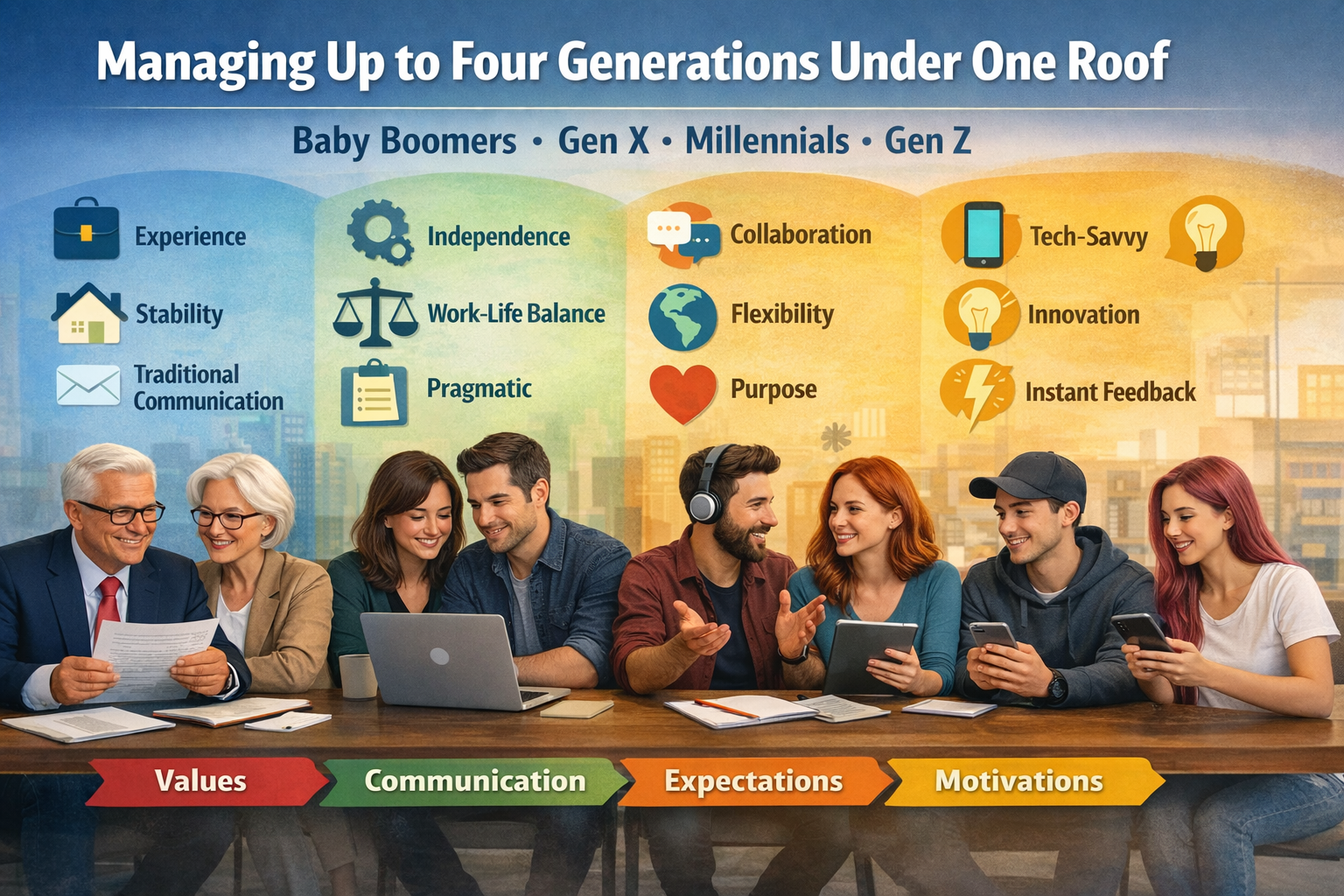
For the first time in history, organisations are managing up to four generations under one roof — Baby Boomers, Gen X, Millennials, and Gen Z. Each group brings different values, communication styles, expectations, and motivations. While this diversity can be a powerful advantage, it can also become a silent barrier to performance if not managed intentionally.
Many leaders assume generational conflict is simply about age. In reality, it is about mindset. Yes! It’s all about our mindset. How we perceive and thereafter react.
Senior employees may value loyalty, structure, and hierarchy. Younger employees may prioritise flexibility, purpose, and rapid feedback. One prefers face-to-face discussions; another prefers instant messaging. One seeks job stability; another seeks growth and recognition. When these differences are misunderstood, frustration grows, communication breaks down, and collaboration weakens.
But here is the truth: generational diversity is not a problem — unmanaged perceptions are.
Without proper guidance, teams may label each other as “too rigid,” “too sensitive,” “too demanding,” or “not committed.” These assumptions create psychological walls that reduce productivity and engagement. Over time, high performers disengage, knowledge transfer slows, and leadership pipelines suffer.
The solution is not to favour one generation over another. The solution is structured soft skills training that reshapes workplace behaviour and expectations.
Managing a multigenerational workforce requires leaders and employees to develop emotional intelligence, adaptability, communication mastery, and mutual respect. It requires shifting from “my way is better” to “how can we leverage our differences?”
Soft skills training plays a critical role in building this bridge. Through guided workshops, employees learn how to:
- Communicate across generational preferences
- Provide and receive feedback constructively
- Align expectations around performance standards
- Resolve conflict professionally
- Value experience while embracing innovation
Most importantly, leaders must be equipped to coach different generations differently. A one-size-fits-all leadership style no longer works. Heads of Departments and managers must understand how to motivate each group while maintaining fairness and consistency.
When organisations intentionally develop these capabilities, something powerful happens. Experience meets innovation. Stability meets agility. Wisdom meets creativity. Instead of competing perspectives, you create complementary strengths.
The result? Stronger teamwork. Faster problem-solving. Higher engagement. Sustainable performance.
If your organization is experiencing communication gaps, disengagement among younger staff, or resistance from senior employees, it may not be a talent issue — it may be a generational alignment issue.
Investing in multigenerational soft skills development is not optional in today’s environment. It is a strategic necessity.
The question is: Are your leaders equipped to unite generations — or are they managing conflict without realizing it?
Let’s help you transform generational diversity into your organization’s greatest competitive advantage.