

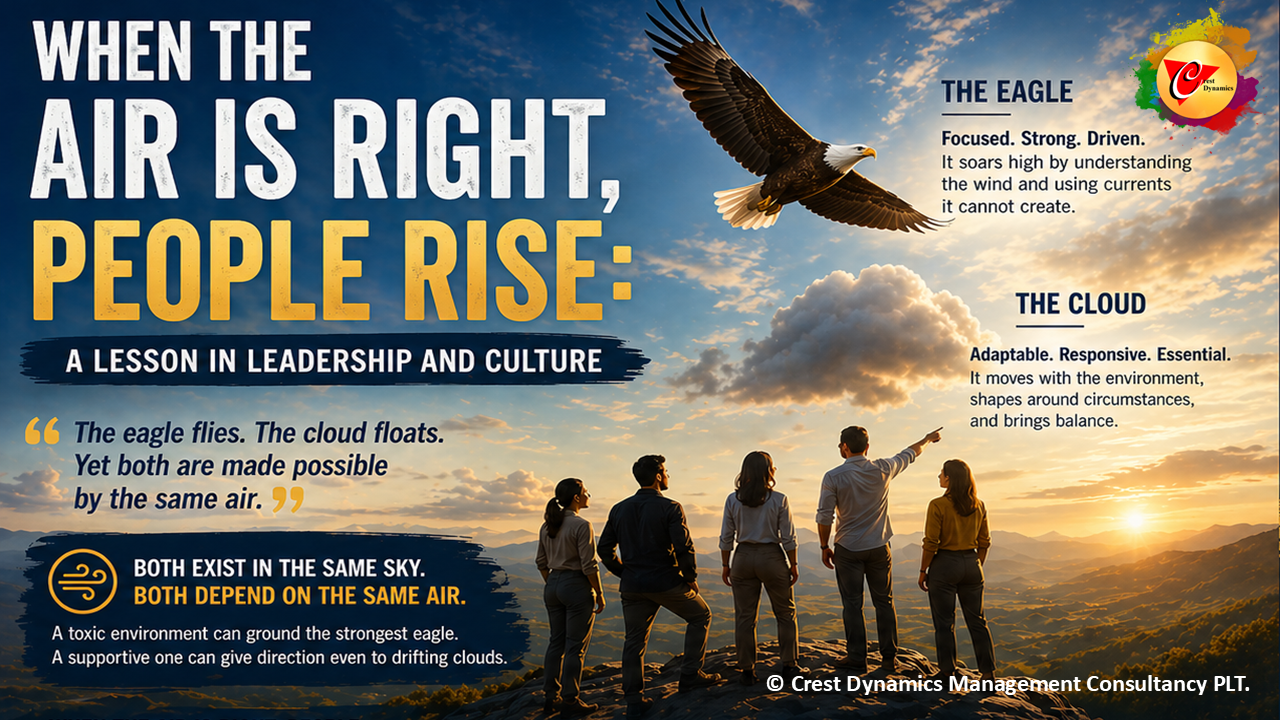
“The eagle flies. The cloud floats. Yet both are made possible by the same air.”
This statement becomes far more powerful when you slow down and really sit with it.
At the workplace, that “air” is not physical—it is the invisible force of culture, leadership, trust, and clarity.
We often celebrate the “eagles” in organizations—the high performers, the decision-makers, the ones who take charge and deliver results. They appear strong, independent, and in control. But even an eagle does not fly on strength alone. It studies the wind, adjusts its wings, and relies on currents it cannot create.
Then there are the “clouds.” Often overlooked, sometimes misunderstood. They don’t push—they adapt. They move with the environment, shaping themselves around circumstances. Yet clouds are not weak; they are responsive. They carry weight, shift direction when needed, and play their role in maintaining balance.
Both exist in the same sky. Both depend on the same air.
And this is where the realization begins.
In many workplaces, we focus heavily on who people are—their skills, personality, performance. But we underestimate what surrounds them. A toxic environment can ground the strongest eagle. A supportive one can give direction even to drifting clouds.
Leadership, then, is not about controlling people—it is about engineering the air.
Is there clarity, or confusion?
Trust, or fear?
Purpose, or mere activity?
These unseen conditions determine whether people rise, drift, or fall.
A great leader understands this:
If the air is right, eagles don’t need to be forced to fly—they will soar.
And clouds won’t wander aimlessly—they will move with meaning.
This perspective shifts responsibility. Success is no longer just about hiring better individuals or pushing harder for results. It becomes about cultivating an environment where different strengths can coexist and thrive.
Because in the end, performance is not created in isolation.
It is shaped by conditions.
And when leaders learn to adjust the “air,” something remarkable happens—
People don’t just work.
They lift.