

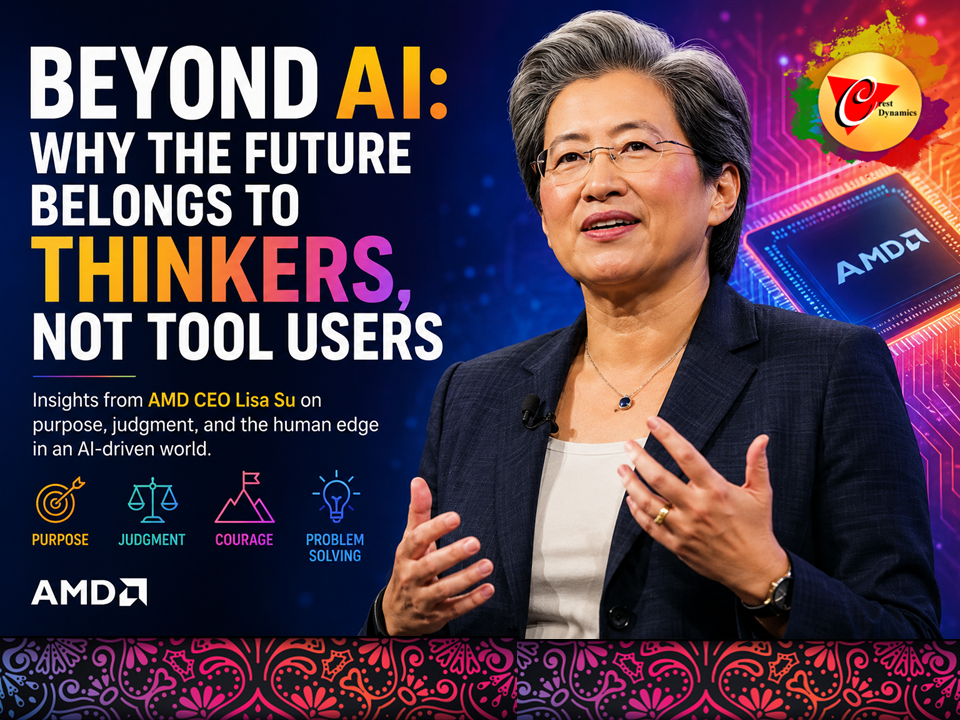
As artificial intelligence reshapes industries at breathtaking speed, a troubling question emerges: Are we preparing people to think—or merely teaching them to use tools?
At the commencement ceremony for MIT’s Class of 2026, AMD CEO Lisa Su delivered a message that cut through the noise surrounding AI. While many graduates are rushing to master the latest AI platforms, Su challenged them to focus on something far more valuable: purpose, judgment, courage, and problem-solving.
According to Fortune, Su told graduates:
“The world does not just need people who know how to use powerful tools, it needs people who know what to use them for, people with a sense of purpose, judgment, courage. People who look at a hard problem and say ‘I know this is really, really important, and we can figure this out’” are the next change-makers.
Her words highlight a distinction many organizations are beginning to overlook. Knowing how to prompt an AI system is useful. Knowing which problem deserves attention in the first place is transformational.
Throughout history, technology has amplified human capability. The calculator did not replace mathematical thinking. Search engines did not replace curiosity. Likewise, AI will not replace the need for wisdom. It will simply magnify the quality of the thinking behind it.
Su described AI as a force capable of accelerating breakthroughs in healthcare, science, energy, and climate research. Yet she emphasized that technology alone cannot determine priorities or accept responsibility for outcomes.
As she explained:
“Now, the way to think about [AI] is it makes each of us more capable, whether you’re talking about medicine, science, energy, [or] climate. But let me be clear about something: Technology itself does not decide what the future looks like, the best people do. For everything that AI can do, AI can’t decide which problems are worth solving. It can’t make the hard judgments when the data is not there. It can’t take responsibility for the outcomes.
These are actually our responsibilities, and they matter now more than ever.”
This may be the defining challenge of the AI era. The winners will not simply be those who possess the most advanced technology. They will be those who cultivate critical thinking, ethical judgment, creativity, and the courage to tackle problems others avoid.
Lisa Su’s message is ultimately a reminder that the future will not be shaped by machines alone. It will be shaped by people who can think beyond the machine. In a world increasingly filled with tools, the rarest and most valuable asset may still be a human being who knows why.