

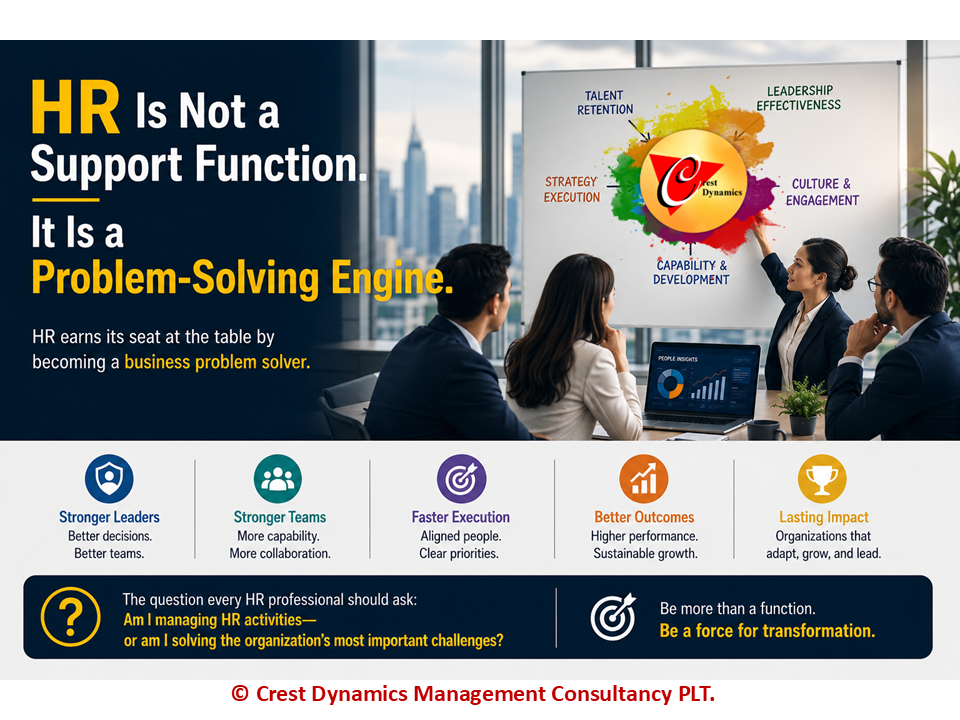
Many HR articles talk about HR as a partner, but that phrase has become overused. A more powerful message is: HR earns its seat at the table by becoming a business problem solver.
The CEO walks into the meeting with one question:
“Why are we losing our best people?”
The finance leader has another:
“Why is productivity declining despite having more resources?”
The operations leader asks:
“Why can’t we execute our strategy fast enough?”
Different questions.
One common thread.
Every business problem is ultimately a people problem.
And this is where modern HR has an opportunity to redefine its role.
For decades, HR was often measured by how efficiently it managed processes—hiring, policies, payroll, compliance, and employee administration.
Important work.
But not transformational work.
The HR leaders who create the greatest impact operate differently. They don’t wait for problems to arrive at their doorstep. They look beneath the surface and ask deeper questions.
Why are talented people leaving?
Why are managers struggling to lead?
Why does a strategy that looks perfect on paper fail during execution?
Why do teams with talented individuals still fail to perform?
These leaders understand something powerful:
Organizations don’t have performance problems. They have capability, culture, and leadership challenges that show up as performance problems.
A great HR leader doesn’t simply fill vacancies—they build talent engines.
They don’t just run engagement surveys—they uncover what prevents people from doing their best work.
They don’t only train managers—they transform them into leaders who can inspire, coach, and develop others.
They don’t present data as information—they turn insights into action.
The future of HR belongs to those who can connect people decisions with business outcomes.
Because when revenue slows, innovation stalls, or execution breaks down, the answer is rarely found in a spreadsheet or a process manual.
The answer is found in understanding people.
The most valuable HR leaders will not be remembered because they created perfect policies.
They will be remembered because they solved the problems that mattered most.
They helped organizations become faster.
They helped leaders become better.
They helped people become more capable than they thought possible.
The question every HR professional should ask is:
“Am I managing HR activities—or am I solving the organization’s most important challenges?”
Because the difference between the two is the difference between an HR department and a true force for transformation.