

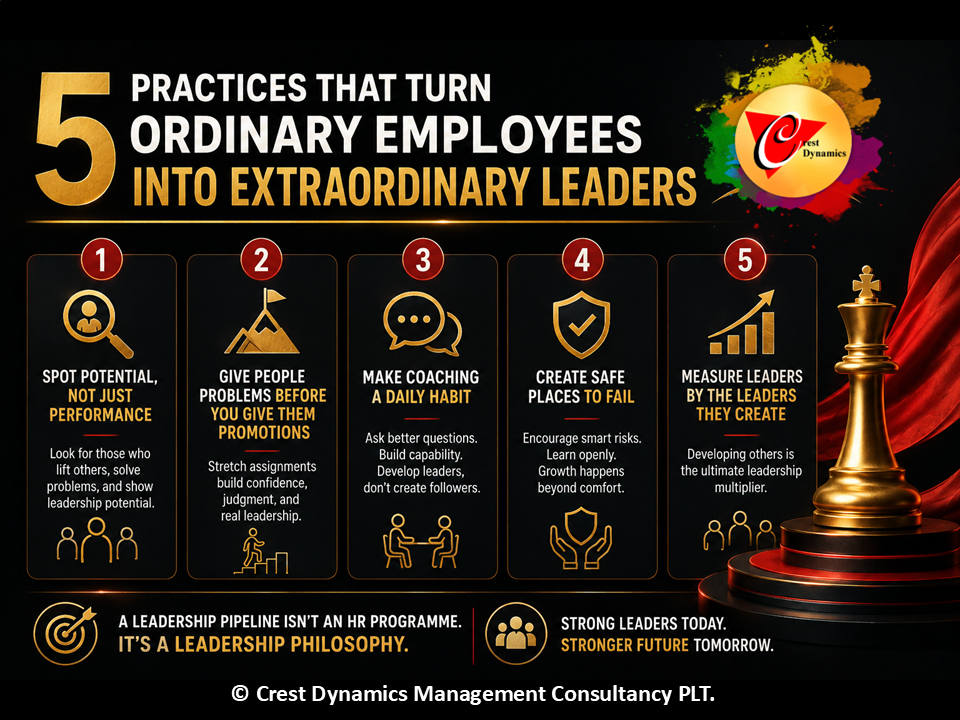
Five Practices That Turn Ordinary Employees into Extraordinary Leaders
Every CEO says people are their greatest asset.
Yet many organizations invest more time planning next quarter’s sales than planning who will lead the business five years from now.
Leadership doesn’t emerge by accident. It is designed.
After studying organizations that consistently produce strong leaders from within, one pattern becomes clear. They don’t rely on luck. They practice five disciplines relentlessly.
1. Spot Potential, Not Just Performance
Your best salesperson won’t automatically become your best sales manager.
High performers deliver results.
Future leaders multiply results through others.
Instead of asking, “Who is performing the best?” ask, “Who helps others become better?”
Sometimes your next leader is the quiet person everyone trusts—not the loudest voice in the room.
2. Give People Problems Before You Give Them Promotions
Leadership isn’t learned in a classroom.
It’s learned in uncertainty.
Assign people to lead a struggling project. Ask them to present to the executive team. Let them manage a difficult customer or work across departments.
Growth rarely happens inside comfortable roles.
3. Make Coaching a Daily Habit
The best managers don’t solve every problem.
They ask better questions.
“What options have you considered?”
“What would you do if I weren’t here?”
“What did this experience teach you?”
Every conversation either builds dependency or develops capability. Great leaders choose the latter.
4. Create Safe Places to Fail
Many organizations punish mistakes.
Great organizations examine them.
When people know they won’t be humiliated for taking thoughtful risks, they become more innovative, more confident, and more willing to lead.
Leadership grows where learning is valued more than perfection.
5. Measure Leaders by the Leaders They Create
Imagine changing one performance metric.
Instead of asking managers only about revenue, productivity, or efficiency, ask:
“Who have you developed this year?”
That single question changes priorities.
Managers stop protecting talent.
They start producing it.
Conclusion
Building a leadership pipeline isn’t an HR programme.
It’s a leadership philosophy.
The organizations that thrive over the next decade won’t necessarily have the smartest people or the biggest budgets.
They’ll have something far more valuable:
A culture where leadership is everyone’s responsibility.
Because in the end, the strongest organizations aren’t remembered for the leaders they hired.
They’re remembered for the leaders they grew.