

Imagine walking into your office tomorrow and discovering that three of your senior leaders have resigned.
Would your organization panic?
Or would someone quietly step forward, ready to lead?
That single question separates organizations that survive from organizations that thrive.
Too many companies spend years searching for the perfect leader when they should have been growing one all along. They celebrate the charismatic executive, the star performer, the “hero” who seems to carry the business on their shoulders. It works—until that person leaves.
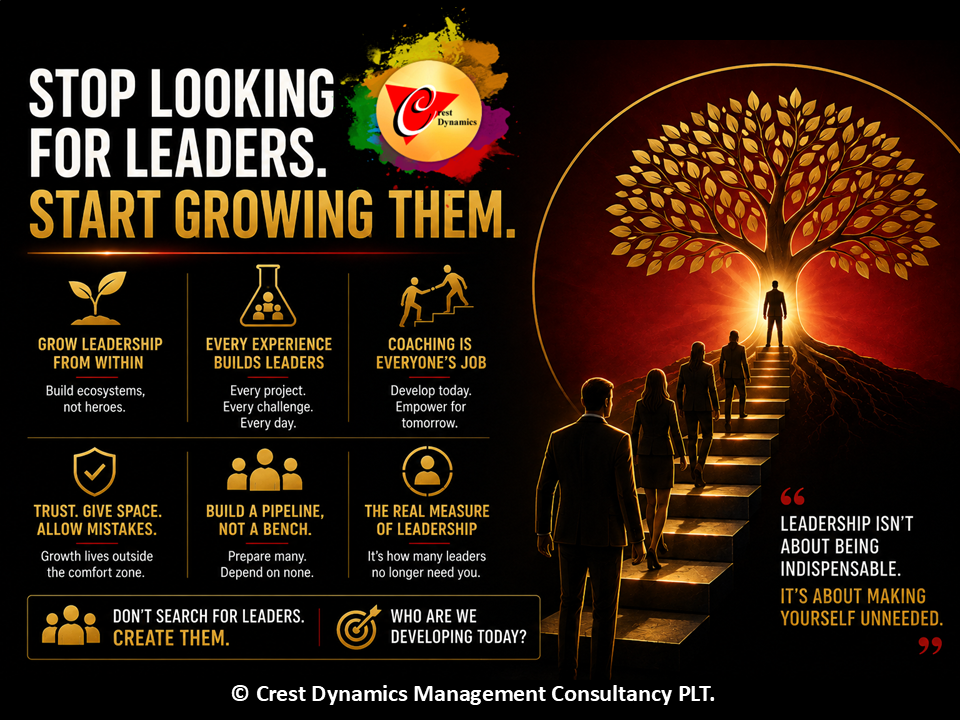
The world’s strongest organizations take a different path. They don’t build heroes. They build ecosystems where leadership grows naturally.
In these organizations, every project is more than work—it is a leadership laboratory. Every difficult assignment is an invitation to grow. Every manager sees coaching not as an annual HR exercise, but as part of their daily responsibility. Leadership isn’t reserved for those with impressive titles. It is nurtured in people long before anyone expects them to lead.
This requires courage. It means trusting people before they’ve proven themselves completely. It means allowing room for mistakes because growth rarely happens inside a comfort zone. It means investing in potential before there is an immediate business need.
The reward is extraordinary.
Instead of scrambling to replace leaders, organizations develop a steady pipeline of people who are already prepared. Instead of relying on a few exceptional individuals, they create hundreds of capable ones. And instead of asking, “Who will replace our leaders?” they begin asking a far more powerful question:
“Who are we developing today?”
Perhaps leadership has never been about standing at the front of the room.
Perhaps its greatest purpose is to ensure that, when you leave the room, someone else is ready to lead.
Because the true measure of leadership isn’t how indispensable you become. It’s how many leaders no longer need you.